Who was the person who was harmed, focus on that person (not the perpetrator). How can the harm be repaired?
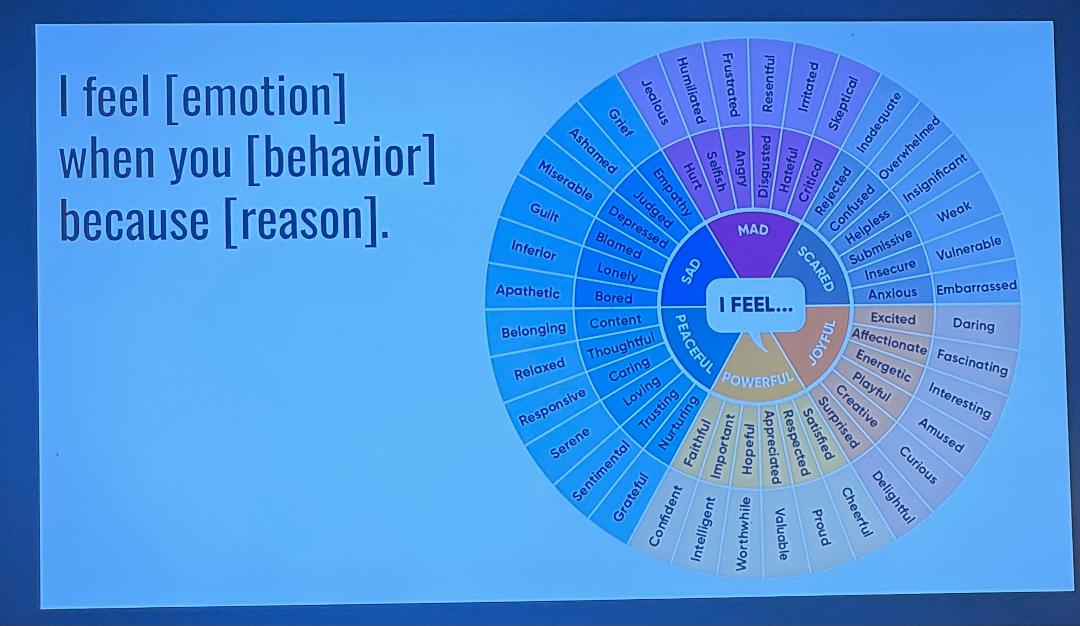
Affective Statements - The point of an affective statement is to communicate our emotions in a way that focuses on the self rather than pointing blame. The most important point is not bringing blame, assumptions, or judgments into the conversation and instead focusing on oneself.
I feel [EMOTION]
When you [BEHAVIOR]
Because [REASON]
"Conflict" defined: when two people have a difference of opinion about the same thing.
Conflict is a naturally occurring phenomenon, but people overwhelmingly see it as a negative thing.
How do we respond to conflict? Most people get emotional (angry, sad, etc.)
The Frontal Lobe of the brain handles reasoning and logic. When one gets emotional their Amygdala takes over and wrests all decision making from the Frontal Lobe. To transfer decision making control back to the Frontal Lobe one has to STOP experiencing the emotional response by calming down for 30 to 90 seconds (take 10 deep breaths).
Active Listening
1. What is each person feeling?
2. What roles are these two people playing?
3. Power agency, how much power does each party have? (in a conflict between a parent and child, determine the needs of the child because the parent usually has most of the power)
4. What are their values?
Try not to give solutions, add advice, give examples from your own life, or focus on the outcome, because it is important that the people in conflict perceive that they are being heard.
Reflection
* Tell the people what you heard them say in a re-phrase
* Match the energy and tone
* Parrot what they said
* Label emotions
* Reflect the four items in Active Listening
Ask both parties "What do you think needs to happen to make things right?"